
Every enterprise AI deployment eventually hits the same wall. The pilot worked because someone hand- wired the agent to your CRM, your document store, and your ticketing system. Then the second agent arrived, and the wiring started again from scratch. That wall is a plumbing problem, and over the past year and a half the industry has largely settled on two protocols to solve it: MCP and A2A. If you are evaluating agent platforms in 2026, these two acronyms are worth ten minutes of your attention.
MCP: how agents reach your systems
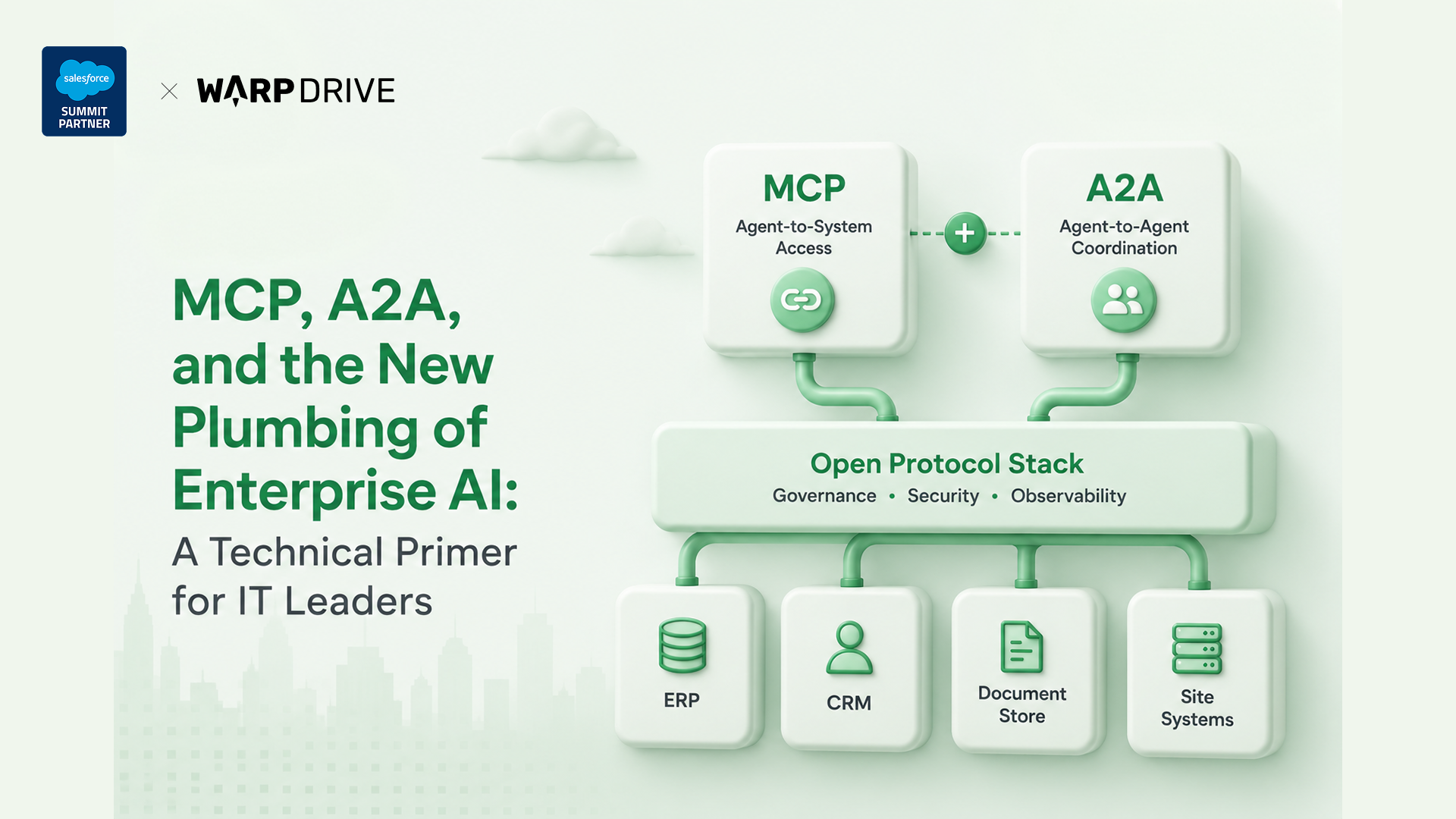
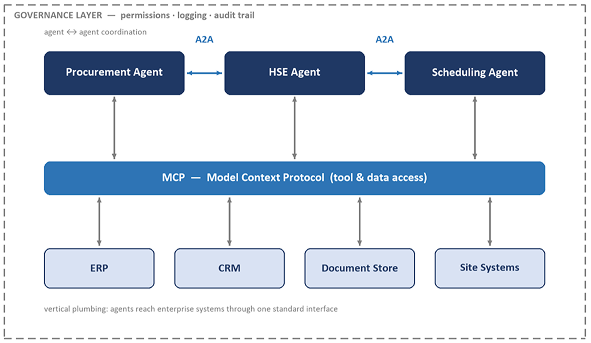
The Model Context Protocol (MCP), introduced by Anthropic and since adopted across the major platforms, standardises how an agent connects to tools and data. Before MCP, every agent-to-system integration was a custom build: one connector for the agent that reads your ERP, another for the one that queries your CRM, each with its own auth handling and its own maintenance burden. With MCP, you stand up one server in front of a system – exposing exactly the functions and data you choose – and any compliant agent can use it. Integration effort shifts from N×M (every agent times every system) to N+M. Your integration backlog stops scaling with your agent count.
A2A: how agents reach each other
Agent2Agent (A2A), initiated by Google and now governed under the Linux Foundation, handles the horizontal connection: agents discovering each other, delegating tasks, and returning results – including across vendors. An agent publishes a card describing what it can do; other agents can find it, hand it work, and track that work through a defined task lifecycle. Without A2A, multi-agent coordination means proprietary orchestration inside one vendor’s walled garden. That works right up until the day you need an agent from outside the garden.
Why the pairing matters
MCP is vertical plumbing (agents down to systems); A2A is horizontal (agents across to agents). Run together, they compound: organisations pairing the two consistently report meaningfully faster workflow development than teams stitching integrations by hand, because the connector work that used to dominate agent projects largely disappears. There is a quieter benefit that matters as much as the speed. A standard interface is also a control point. When every tool call passes through MCP and every handoff through A2A, you finally have somewhere consistent to enforce permissions, log actions, and audit decisions – the governance layer that siloed agents never had.
Three questions for your next vendor demo
- Which protocols do you support natively – and which of our systems would need custom
adapters?
Bespoke connectors are how silos get built. - Can we scope and log what each agent accesses through MCP?
Tool access without per-agent permissions is an audit finding waiting to happen. - How do your agents coordinate with agents we buy from someone else – open A2A, or proprietary
orchestration?
This is the lock-in question. Ask it early.
Where to start
At WarpDrive, mapping this stack is where our engagements begin: which agents you already run, what each one can reach, and what it will take to bring them onto open protocols with governance built in. If your agents were bought before the standards settled, talk to us – we will assess what you have before you buy anything else