
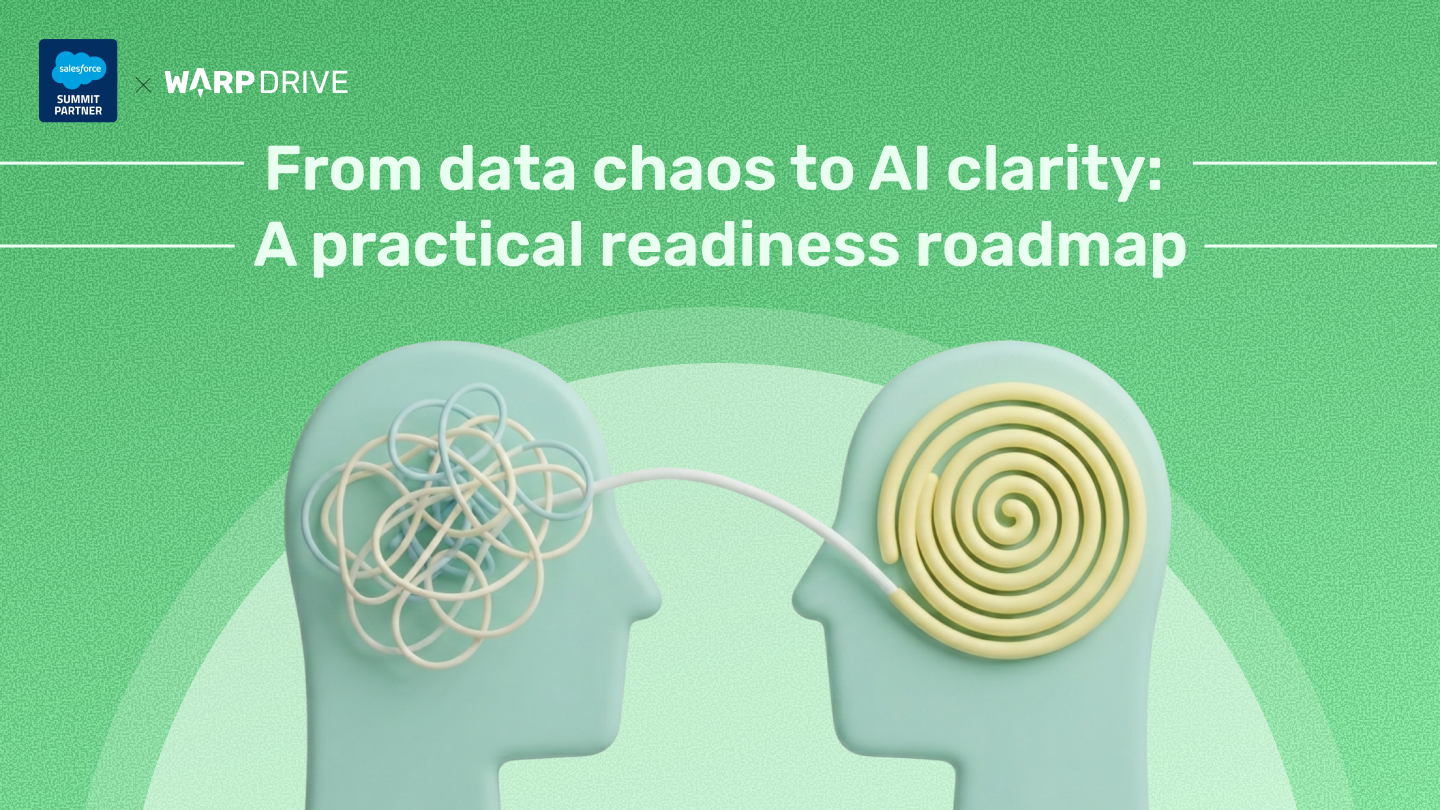
Every CXO has heard the pitch: AI will transform the business. Fewer have been told what has to happen first untangling the chaos sitting underneath it. Duplicate customer records. Three departments with three different versions of the same revenue number. A CRM that doesn’t talk to the ERP, and an ERP that doesn’t talk to anything. That isn’t a data problem you fix later. It’s the actual starting line.
We see this up close. Across 400+ Salesforce and AI engagements in 19 industries, the failure point is almost never the model — it’s everything sitting underneath it. Gartner puts a number on what shows up in nearly every one of our early client conversations: 87% of organizations say poor data quality has slowed their AI progress. Agentforce and its peers don’t fail loudly when the data is bad. They act confidently on the wrong information, which is worse.
The good news: getting from chaos to clarity isn’t a mystery. It’s a sequence. Here’s the roadmap — the same one we run before any Agentforce or AI engagement goes live.
Stage 1: Audit before you architect.
Before buying a single AI tool, map what data you actually have, where it lives, and who owns it. Most organizations skip this because it feels like busywork. It isn’t it’s the only way to know whether you’re building on rock or on sand.
This is exactly where we start every Agentforce engagement: a two-week data readiness assessment, not a two-month one. Five checks tell you almost everything — duplicate record rate (anything above 3% is a deployment risk), completion rate on the fields your workflows actually depend on, metadata consistency (“Active,” “active,” and “ACTIVE” read as three different values to an agent), integration lag between your systems, and whether field labels match what the field actually holds. Agentforce acts on what it sees. It doesn’t pause to ask if the data looks right first.
Stage 2: Consolidate the sources of truth.
Pick one system of record per data type one customer database, one revenue number, one product catalog and make every other system defer to it. This is unglamorous work with enormous payoff: an AI model fed five contradictory answers won’t magically produce a sixth, correct one.
This is the job Salesforce Data Cloud was built for — pulling CRM, ERP, service history, and commerce data into one real-time profile so every downstream system, and every agent action, draws from the same truth. It’s consistently the step teams try to skip in favor of “getting the agent live faster.” It’s also consistently the reason the agent doesn’t stay live.
Stage 3: Build the pipelines before the pilot.
Integration is the part no one wants to budget for, and the part that decides whether anything you build later actually works. Clean data trapped in a system that can’t share it in real time is still, functionally, unclean data.
We treat this as its own deliverable, not a footnote before the demo. On one recent deployment, replacing a stack of manual approvals and disconnected handoffs with a properly integrated Agentforce Operations layer cut the client’s operating costs by 65% and took their average approval cycle from five days to 2.4 — without a single new tool added to the stack. That’s what a working pipeline is worth in a P&L, not just an architecture diagram.
Stage 4: Pilot on your cleanest slice.
Don’t launch your first AI initiative on your messiest, highest-stakes process. Pick the use case where your data is already in the best shape, run it end to end, and use it to prove the model for the tool and for the organization’s trust in it.
Here’s the part most roadmaps leave out: 88% of AI pilots never reach production, and it’s rarely the technology. Most never connected to a real business problem in the first place. The organizations in the successful 12% do four things differently — they start with one business outcome, fix the data early instead of patching it later, name an owner before day one, and prove value fast instead of scaling a pilot no one has validated yet. Pick one bottleneck. Start small. Make it something people can feel.
Stage 5: Institutionalize the discipline.
Data hygiene isn’t a project with a finish line; new sources, new tools, and new teams will keep introducing new mess. Build a standing owner, a review cadence, and clear rules for what “clean enough” means that before the next initiative, not after it stalls.
This is also where continuity quietly becomes a data strategy. A standing owner only works if the people who understand the systems are still around next quarter to enforce the rules turnover is often the real reason “clean enough” erodes within a year. It’s one reason we keep our own delivery teams under 5% attrition: institutional memory turns out to be a data-quality control, not a nice-to-have line on a slide.
Where clarity actually comes from
None of these stages require exotic technology. They require sequencing i.e doing the boring work in the right order instead of skipping straight to the model and hoping the data catches up. Every organization that’s stuck on stage zero got there the same way: by treating data cleanup as a prerequisite to check off, instead of a discipline to maintain.
The roadmap isn’t a one-time fix. It’s the operating rhythm that makes every AI initiative after the first one faster, cheaper, and more trustworthy.
Chaos isn’t a reason to wait on AI. It’s just the first stage of the roadmap and the one most competitors are still stuck on.
Where WarpDrive fits
This roadmap is the same sequence WarpDrive runs before any Agentforce or AI engagement goes live starting with a two-week data readiness assessment, not a lengthy audit. We’ve run it across 400+ Salesforce and AI engagements in 19 industries, which is mostly why it stays five stages instead of growing a sixth. If you want a straight answer on which stage your organization is actually on, that’s a fifteen-minute conversation, not a sales pitch. Reach out and we’ll tell you where you stand.