
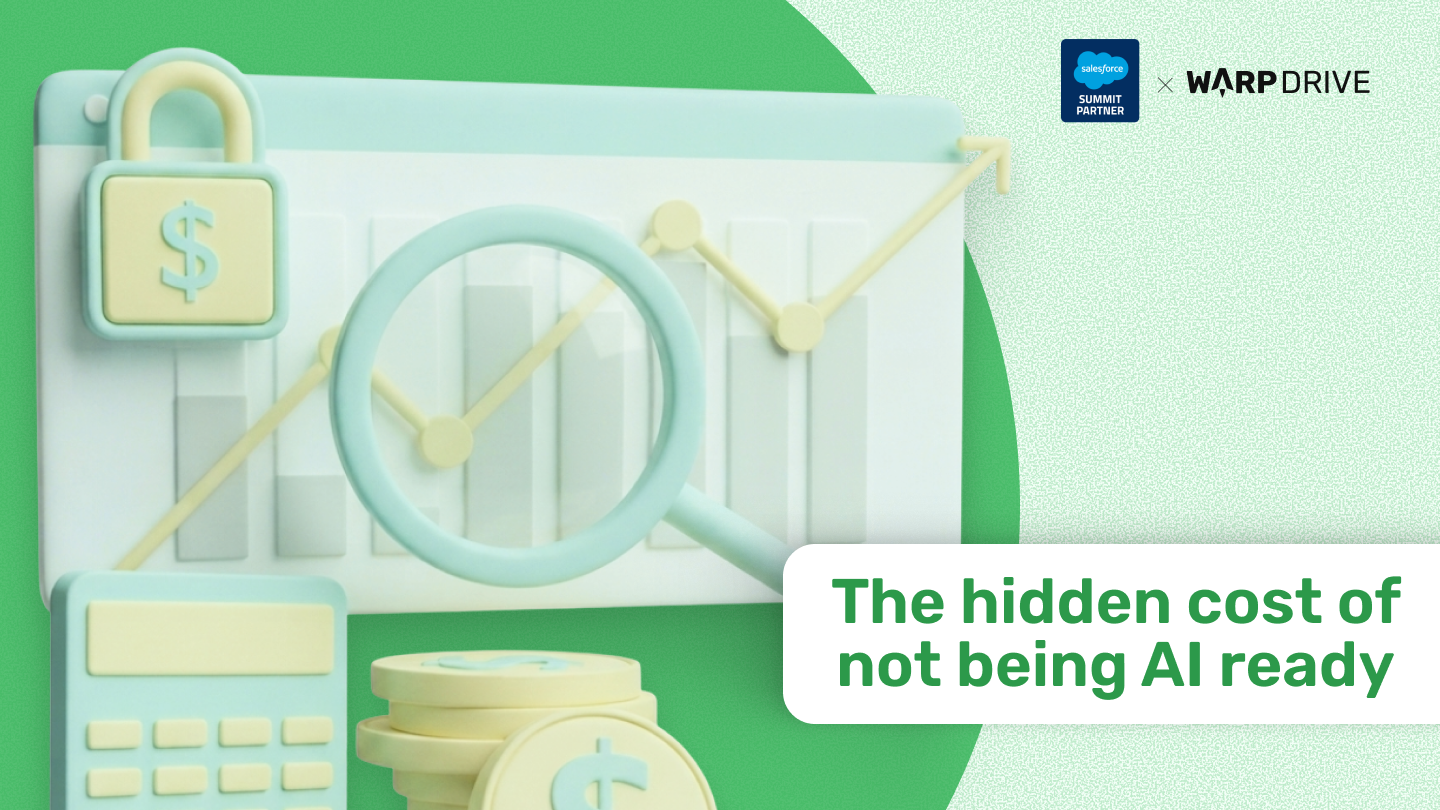
Every AI business case has a line for software licensing, a line for integration hours, and a line for training. What it almost never has is a line for the costs that don’t show up on an invoice the ones that accumulate quietly and only show up later, in a different budget entirely.
We see this constantly in early client conversations: the invoice-based costs are the ones that get budgeted, and the compounding ones are the ones that get discovered. Across 400+ engagements, the organizations that treated readiness as a genuine business case, not just a software line item, were the ones that caught these before they got expensive.
Here are five of them.
The talent you don’t know you’re losing
Ambitious people increasingly ask about AI tooling in interviews the way they used to ask about remote work policy. When the honest answer is “we’re still figuring that out,” some candidates quietly take the other offer. You never see this cost as a line item it shows up as a slightly weaker slate of finalists, quarter after quarter, until someone finally asks why the last few hires all came from a shrinking pool.
We see the inverse of this constantly: candidates ask us directly whether a role touches Agentforce or Data Cloud work, and it shapes who says yes. A team’s own attrition rate is itself a readiness signal ours runs under 5%, which means the people who understand the systems are still around to make the next hire’s first quarter easier, not harder.
The price tag that rises while you wait
Readiness doesn’t get cheaper the longer you defer it. Every quarter of delay means the AI-literate talent you’ll eventually need has gotten more expensive, the competitors who moved first have locked in the better vendor terms, and the internal skepticism about “another AI initiative” has had longer to calcify. The business case that looked marginal last year gets compared against a higher bar next year, not a lower one.
This is exactly the curve we built our own delivery model around. Resourcing at $35–$55 an hour against an industry average of $85–$190 only works because we front-load the cheap conversations before any large commitment, so the expensive mistake never gets made in the first place. Waiting doesn’t lower that bill. It just moves the decision to a year when the same groundwork costs more and buys less runway.
The judgment that walks out the door
Your most experienced people carry a version of the business in their heads that’s never been written down how a tricky account actually gets renewed, why a certain client always needs handling a specific way. Organizations with real AI readiness capture some of that judgment as it’s exercised. Organizations without it lose it entirely the day that person retires or leaves, and only notice the gap the next time the same situation comes up.
This is close to the exact problem we’re called in to fix when we take over an underperforming Salesforce org the “Red Account” work that’s turned 45%+ of the accounts we’ve inherited from red to green. The technology is rarely the hard part. The hard part is reconstructing decision logic that lived in one person’s head and was never written down anywhere a system could learn from it.
The exposure sitting in someone’s personal account
Employees are already using AI tools, readiness or not usually through personal logins, on unmanaged devices, with company data pasted into the prompt. This doesn’t show up as a cost until it becomes an incident: a client’s data in a tool no one approved, a compliance question no one can answer cleanly. The absence of a policy isn’t the absence of risk it’s just risk with no owner.
This is the same failure mode we flag in every data readiness check we run: inconsistent handling stays invisible right up until an agent or a tool acts on it, and then it’s a governance incident, not a data one. Governance isn’t red tape here it’s the only thing that makes it safe to let people actually use the tools they’ve already found on their own.
The discount no one mentions out loud
Acquirers and investors are increasingly running AI readiness diligence alongside financial diligence, and a weak answer doesn’t just raise questions it gets priced in. A buyer who has to assume six figures of remediation work before your systems are AI usable will simply build that assumption into the offer. You won’t see this cost until the term sheet, and by then it’s not negotiable, it’s already decided.
We’ve sat on the other side of this exact review more than once, effectively running AI and data readiness diligence before a deal, not after one. The same questions we ask before any Agentforce engagement apply just as well in a term sheet negotiation as they do in a project kickoff, and asking them early is considerably cheaper than skipping them.
Why these costs stay invisible
None of these show up in a standard ROI model because none of them are a bill you receive. They’re a slower hiring funnel, a rising catch up cost, a knowledge gap, an unmanaged risk, a discounted valuation each easy to dismiss individually, and easy to miss entirely if the business case only counts what has a price tag attached.
The real cost of not being AI ready was never the software you didn’t buy. It’s everything that kept happening anyway while you waited to decide.
Where WarpDrive fits
Every cost above is a version of the same problem: a gap nobody put a number on until it was already expensive. Across 400+ engagements in 19 industries, the earlier we’re in the conversation, the cheaper these gaps are to close. Reach out we’re happy to talk through what this looks like for your organization.