There's a conversation happening in manufacturing right now that goes something like this:
"We're deploying AI agents to automate vendor onboarding and PO approvals."
Two months later: "The agents keep escalating everything back to the team. We're not sure why."
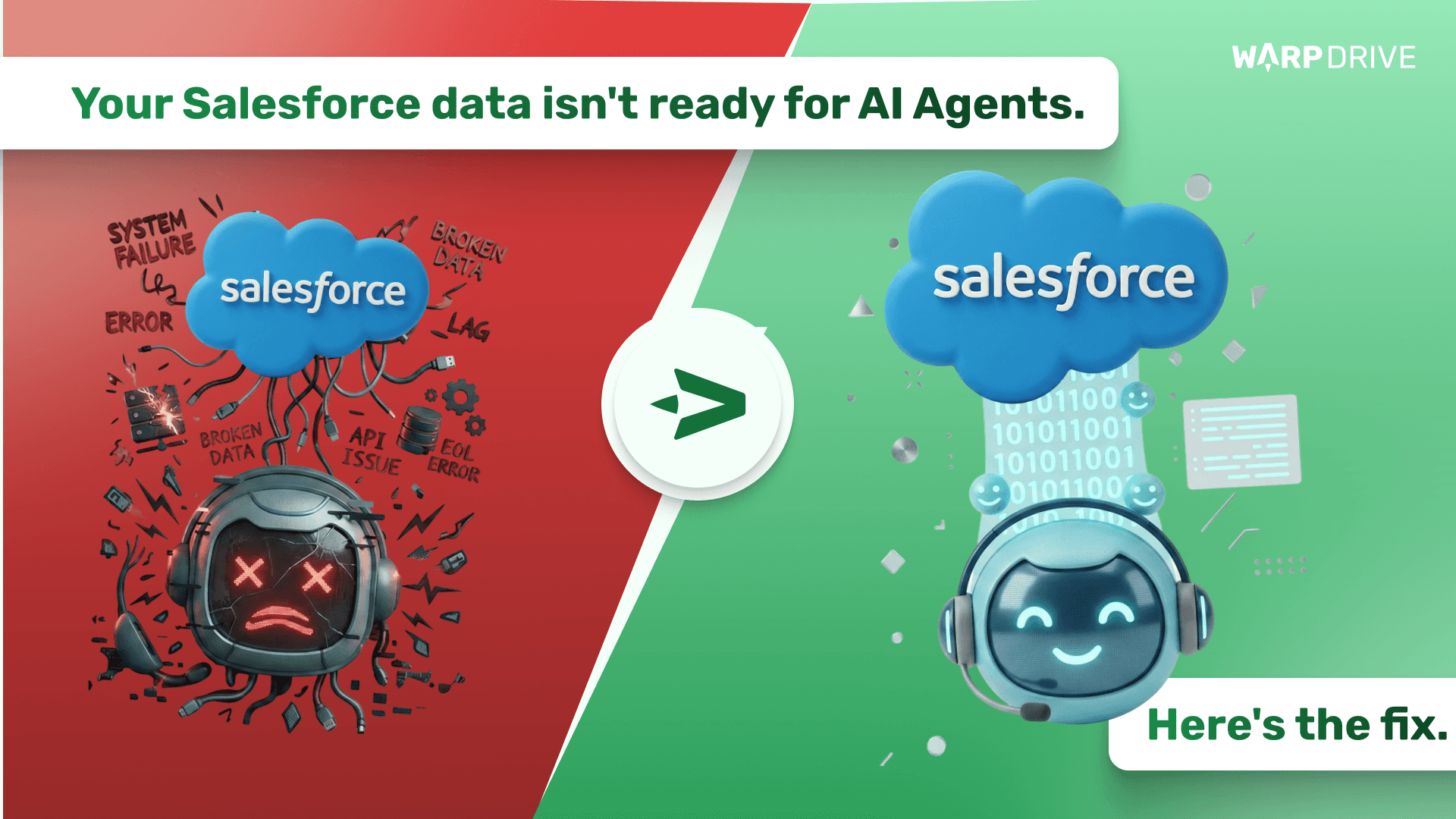
The technology isn't the problem. The data underneath it is.
Salesforce Agentforce is only as reliable as the data it runs on. Right now, most enterprise Salesforce environments weren't built with AI agents in mind - they were built to support people doing manual work. That means the gaps, inconsistencies, and duplicates that humans quietly worked around every day become hard blockers the moment an agent tries to act on them.
Gartner put a number on this in February 2025: 60% of AI projects lacking AI-ready data will be abandoned - not because the AI failed, but because the foundation was never there to begin with.
What This Actually Looks Like on the Shop Floor
In manufacturing, bad data doesn't announce itself as a data problem. It shows up as:
A purchase order routed to the wrong plant because vendor location fields are inconsistent across regions. A shipment held up because a compliance field was left blank during onboarding. A capacity allocation that looks correct in Salesforce but doesn't match what's actually available in the ERP. An agent that can't complete a decision and escalates - every time - because the records it depends on are incomplete.
Each of these looks like an operational problem, and it is. But the root cause is almost always a data readiness issue that existed long before the agent arrived.
The difference is that a human would quietly fix it, ask a colleague, or make a judgment call. An agent doesn't have that option. It either acts on what's there or it stops and asks for help. At scale, that becomes a bottleneck that cancels out every efficiency gain you were chasing.
What "AI-Ready" Data Actually Means
It's not a complicated concept, but it does require deliberate work.
AI-ready data means complete records - no critical fields left blank because they were optional when the form was built. It means consistent field definitions across systems - the same vendor isn't called three different things in Salesforce, your ERP, and your finance platform. And it means aligned integrations - so when an agent pulls a record, it gets a single, accurate picture, not a patchwork of conflicting data points.
Most Salesforce environments we work with sit somewhere in the middle. The data is good enough for human workflows. It's not good enough for autonomous agents making decisions at volume.
That gap is fixable, but it has to be addressed before you scale - not after the first round of failures.
The Three Places It Breaks First
In our experience working with manufacturing operations teams, data-related agent failures tend to cluster around the same three areas:
Allocation and routing errors.
Orders get sent to the wrong plant. Capacity gets misallocated. Dispatch timelines slip and escalations start. These failures are usually traceable to inconsistent location or capacity data that nobody flagged because the manual process had a workaround built in.Compliance and audit gaps.
Incomplete vendor records or missing certification fields cause agents to flag exceptions or skip steps they shouldn't. What surfaces as a compliance risk is almost always a data completeness problem.Manual fallback at scale.
When agents can't trust the data, they escalate. When everything escalates, the team that was supposed to benefit from automation ends up busier than before. This is the failure mode that kills internal confidence in AI initiatives faster than anything else.
Where to Start: The WarpDrive Approach
We don't recommend a full data overhaul before going live. That takes too long and loses momentum. Instead, we work with clients on a focused, phased approach that gets one process running cleanly — then builds from there.
Start with a focused audit on one object.
Pick the record type most central to the process you're automating - a Vendor, a PO, a Work Order, or an Asset. Trace how it actually flows across systems: where it's created, where it's updated, where it's read, and where it breaks down. You'll find the gaps faster than you expect.Clean and standardise before you connect.
Remove duplicates, enforce required fields, and align data definitions across Salesforce and your connected systems. This doesn't have to be perfect - it has to be good enough for an agent to act reliably on the records it touches.Test with a real agent on real scenarios.
Run the agent against live data and watch where it hesitates, escalates, or fails. Every failure point is a data quality finding. Build those findings into your remediation backlog.Govern before you scale.
Assign clear ownership to critical data fields. Put controls in place so the records stay clean as the process grows. Data quality without governance degrades - and you'll be back to the same problem six months later.
This sequence won't solve everything, but it gives you a working, trustworthy process that you can actually build on - instead of an ambitious deployment that quietly returns to manual work.
The Real Question Before You Scale
Every manufacturing operation we talk to has some version of this problem. The question isn't whether your data needs work - it does. The question is whether you find that out before go-live or after.
Getting ahead of it isn't just about protecting the AI investment. It's about not burning out the team that has to pick up every escalation when agents can't complete their work.
At WarpDrive, we help manufacturing and operations teams get their Salesforce data into a state where AI agents can actually be trusted to act on it - without months of overhaul before you see results.
If you ran a focused audit on your most critical object tomorrow, which process would you trust enough to automate first?
(Gartner, "Lack of AI-Ready Data Puts AI Projects at Risk," February 2025)